The State of AI Search in the Philippines 2026
Prepared by SuperVouch, an AI search visibility (AI SEO) agency · Published June 2026
We audited 111 of the country's biggest brands to answer one question: when a buyer asks AI who is best, can these brands even be read? The results are worse than we expected, and a wide-open opportunity for anyone paying attention.
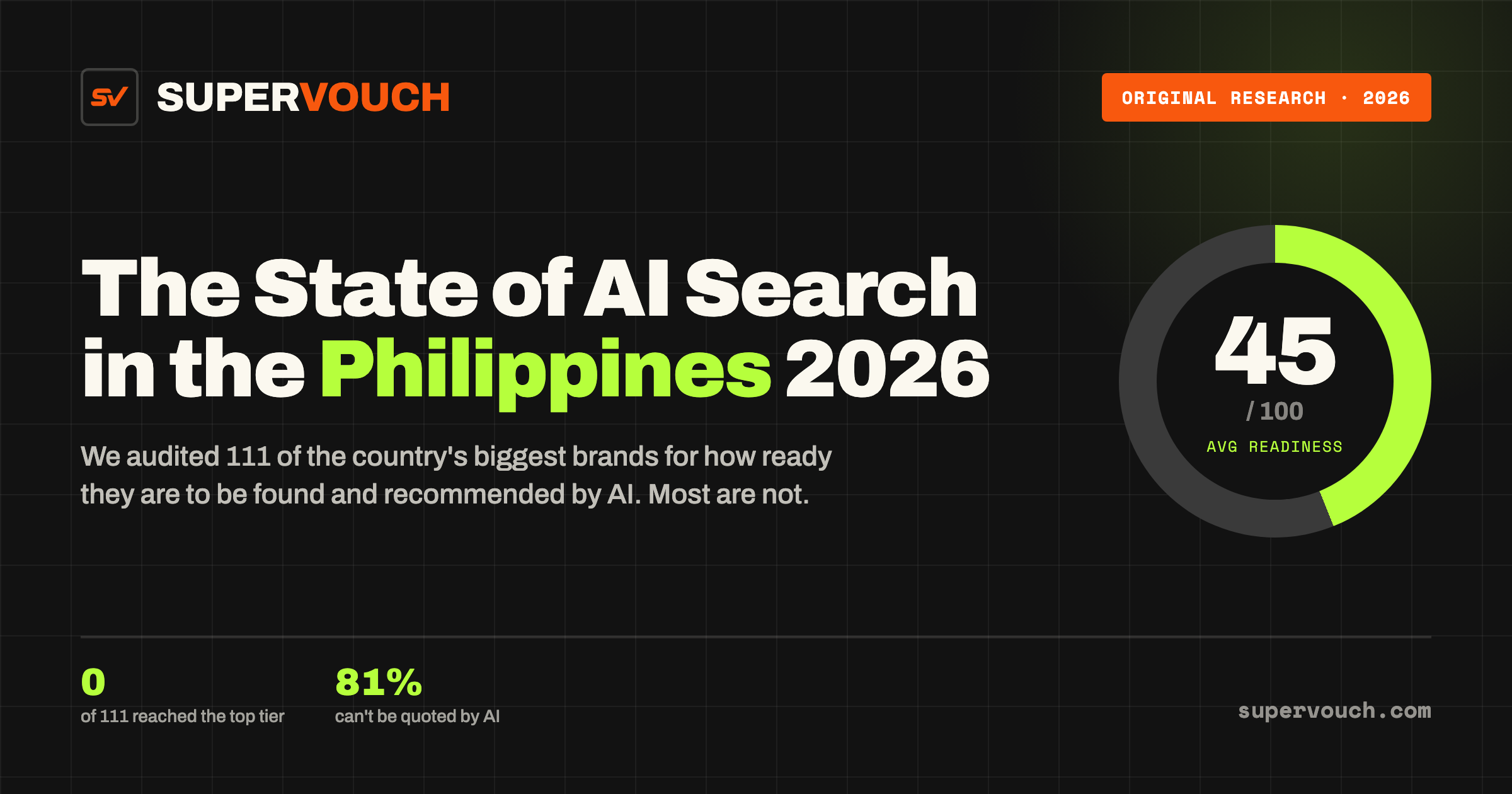
The short version: the average Philippine brand we audited scored 45 out of 100 on AI-readiness. Not one of 111 reached the top tier. 81% had zero answer-ready content, the single thing AI engines need to quote you. The brands that win AI search in the Philippines over the next two years are being decided right now, by who fixes this first.
Foreword
We have spent close to two decades watching search reinvent itself, from the link-building era to mobile to the rise of intent and entities. AI search is the biggest shift yet, and right now it is mostly talked about, not measured. So we measured it. Everything below is what the machines actually see when they look at the Philippines' biggest brands. It is not opinion. It is the scoreboard, and almost no one has looked at it.
The seven findings that matter
1. Nobody is ready.
Zero of 111 brands reached the top tier. The best brand in the country scored just 76 out of 100. The Philippines does not have an AI search leader yet. It has a vacancy.
2. The 81% Problem.
81% of top Philippine brands have zero answer-ready content, the one thing AI engines need to quote you. It is the single most common failure, in every sector, with no exceptions. Fix this one thing and most brands jump a full band.
3. The Visibility Paradox.
Fame works against you. The biggest, most-recognized brands often scored worst, because their heavy, image-first sites are the hardest for a machine to read. A bootstrapped tax app outscored a universal bank. Offline fame and AI-readiness are nearly unrelated.
4. The Legacy Penalty.
How modern your web stack is predicts AI-readiness better than your revenue does. Digital-native sectors like SaaS lead. The sectors with the biggest offline footprints, telco, fast food, and travel, trail by 20 points or more.
5. One in five are locking the door.
19% actively block or restrict AI crawlers, usually by accident, through a stray setting or security rule. They have removed themselves from AI answers entirely and most do not know it.
6. Beauty is the great illusion.
Some of the most beautifully designed sites scored the worst. Gorgeous, image-first, and almost invisible to a model. Design that wins humans can lose machines completely.
7. The throne is empty, for now.
Because no brand is strong, the recommendation slot in every Philippine category is unclaimed. This is a first-mover window, and it closes the moment competitors wake up.
"There is no number one in AI search in the Philippines yet. Every throne is empty, and someone is about to sit down."
Methodology
We ran SuperVouch's AI-readiness audit on the live websites of leading Philippine brands across fifteen sectors in June 2026. Each site is scored 0 to 100 on how easily AI engines can crawl, read, and quote it: server-rendered content depth, structured data, answer-ready content, AI crawler access, llms.txt, entity signals, and technical hygiene. Twenty-five sites blocked our crawler or failed to respond and were excluded, leaving 111 in the dataset. This measures on-page AI-readiness, the foundation of AI search visibility, not third-party corroboration.
How the Philippines scored
Every brand falls into one of four bands. Here is where the 111 landed.
The shape says it all. The top tier is empty. The mass of the country's biggest brands sits in "at risk" and "critical," meaning AI engines struggle to read them at all.
🏆 The top 10 most AI-ready brands in the Philippines
Out of 111 brands, these 10 are the most ready to be found and recommended by AI. Notice the pattern: a HR-tech firm and an outsourcing company tie for first, a college beats every bank and telco, and not one is a household consumer name. The brands winning AI search are the ones that grew up digital.
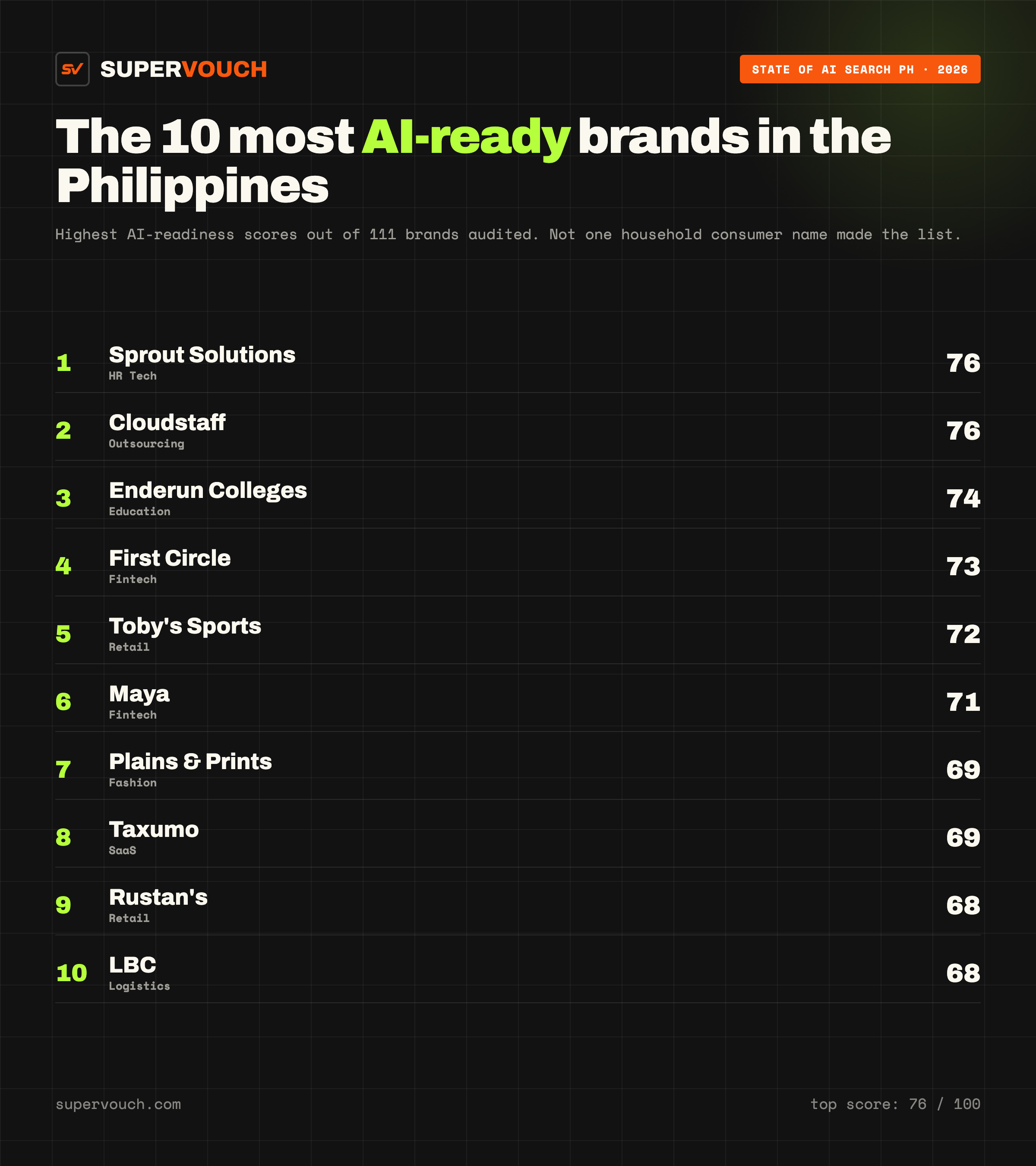
| # | Brand | Sector | Score |
|---|---|---|---|
| 1 | Sprout Solutions | SaaS & Tech | 76 |
| 2 | Cloudstaff | SaaS & Tech | 76 |
| 3 | Enderun | Education | 74 |
| 4 | First Circle | SaaS & Tech | 73 |
| 5 | Toby's Sports | Fashion | 72 |
| 6 | Maya | Fintech & Banking | 71 |
| 7 | Taxumo | SaaS & Tech | 69 |
| 8 | Plains and Prints | Fashion | 69 |
| 9 | Rustan's | E-commerce & Retail | 68 |
| 10 | LBC | Logistics & Delivery | 68 |
Even the leaders top out in the 70s. There is no Philippine brand we found that is genuinely "strong" for AI search yet. That slot is open.
⚔️ Sector showdown: the Legacy Penalty
Average AI-readiness by sector. Call it the Legacy Penalty: the brands that grew up online are pulling ahead, and the ones with the biggest TV budgets and the oldest web stacks are asleep.
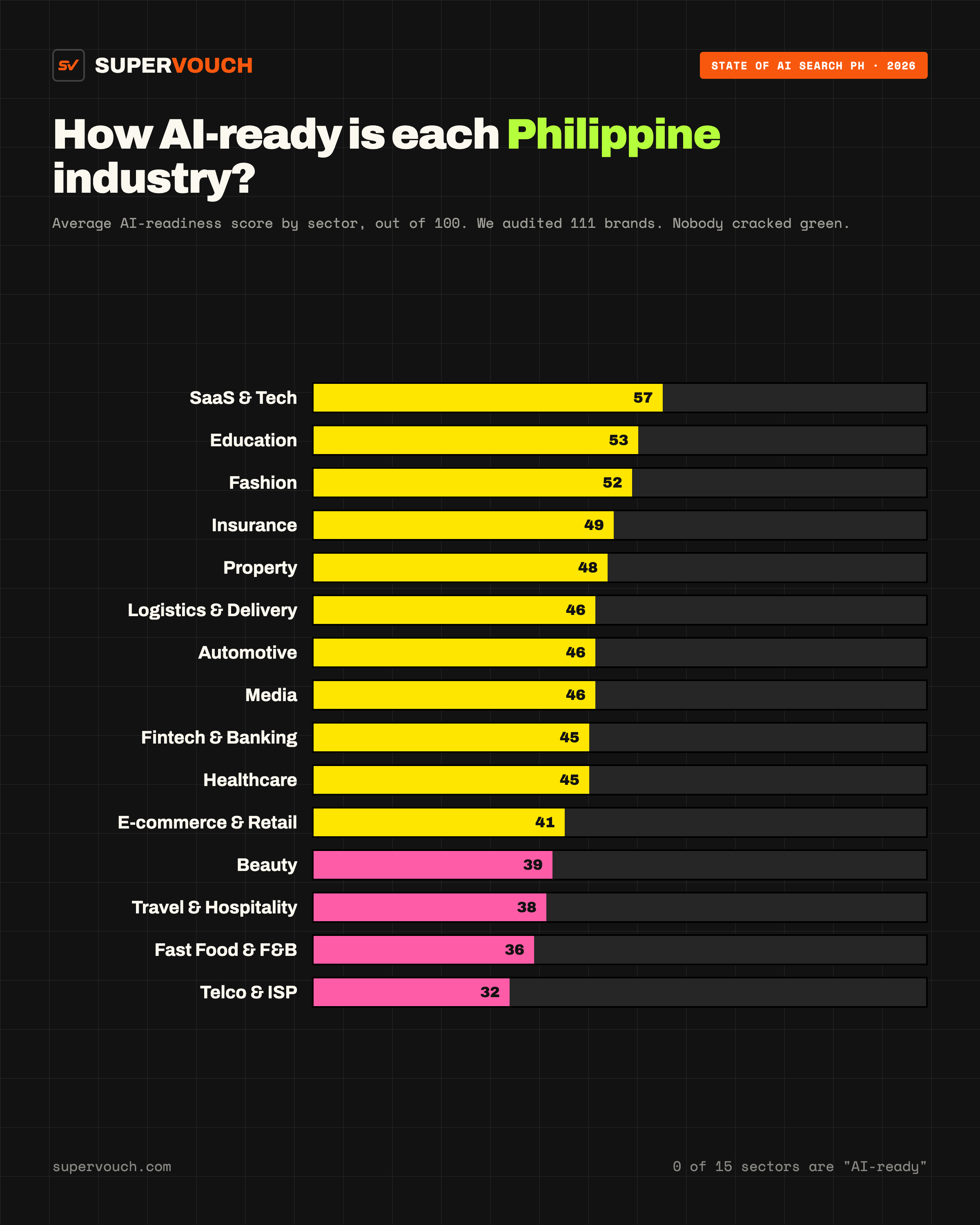
SaaS and tech lead because crawlable, structured sites are part of how they operate. Telecoms now sit dead last: the companies that sell internet access turn out to be among the hardest to read on it. A major fast-food brand scored 39, a flag-carrier airline scored 17, and the lowest score in the entire study was 14.
The full sector breakdown
| Sector | Brands | Avg score | Zero answer-ready | Blocking AI |
|---|---|---|---|---|
| SaaS & Tech | 11 | 57 | 45% | 0% |
| Education | 7 | 53 | 100% | 0% |
| Fashion | 8 | 52 | 88% | 13% |
| Insurance | 4 | 49 | 75% | 0% |
| Property | 8 | 48 | 88% | 25% |
| Logistics & Delivery | 6 | 46 | 83% | 17% |
| Automotive | 5 | 46 | 60% | 0% |
| Media | 4 | 46 | 100% | 50% |
| Fintech & Banking | 10 | 45 | 70% | 20% |
| Healthcare | 9 | 45 | 67% | 11% |
| E-commerce & Retail | 10 | 41 | 100% | 0% |
| Beauty | 9 | 39 | 89% | 22% |
| Travel & Hospitality | 5 | 38 | 100% | 20% |
| Fast Food & F&B | 10 | 36 | 100% | 10% |
| Telco & ISP | 5 | 32 | 60% | 20% |
Read across any row and the story repeats: decent intentions, but almost nothing built to be quoted, and some still blocking the engines outright.
The brand to beat in every sector
If you want the benchmark for your industry, here it is: the single highest-scoring brand in each of the 15 sectors we audited, and how far ahead of its sector average it sits.
| Sector | Sector leader | Score | Sector avg | Lead |
|---|---|---|---|---|
| SaaS & Tech | Sprout Solutions | 76 | 57 | +19 |
| Education | Enderun | 74 | 53 | +21 |
| Fashion | Toby's Sports | 72 | 52 | +20 |
| Insurance | Pru Life UK | 63 | 49 | +14 |
| Property | Camella | 61 | 48 | +13 |
| Logistics & Delivery | LBC | 68 | 46 | +22 |
| Automotive | Carmudi | 55 | 46 | +9 |
| Media | Philstar | 55 | 46 | +9 |
| Fintech & Banking | Maya | 71 | 45 | +26 |
| Healthcare | Maxicare | 67 | 45 | +22 |
| E-commerce & Retail | Rustan's | 68 | 41 | +27 |
| Beauty | Happy Skin | 58 | 39 | +19 |
| Travel & Hospitality | Okada Manila | 54 | 38 | +16 |
| Fast Food & F&B | Army Navy | 44 | 36 | +8 |
| Telco & ISP | PLDT Home | 42 | 32 | +10 |
In most sectors the leader is miles ahead of its peers, proof this is winnable, and that whoever moves first in a category gets daylight. Note who is NOT leading: not the biggest bank, not the biggest telco, not the most famous restaurant.
Sector by sector: where every Philippine industry stands
Fifteen industries, 111 brands, ranked best to worst. Each card shows the sector average, the brand to beat, the full range from worst to best, the share with zero answer-ready content, and what it all means.
SaaS & Tech
Software companies live or die by their websites, and it shows. This was the only sector where multiple brands cleared 70: Sprout Solutions and Cloudstaff tied for the national top score at 76, with First Circle at 73 and Taxumo at 69. Cloudstaff also posted the highest answer-readiness score in the entire study, 10 of 16, the closest any Philippine brand came to writing for AI on purpose. The lesson the rest of the country can borrow is blunt: clean, server-rendered pages with real structured content are not a nice-to-have, they are the whole foundation. If your industry wants a benchmark to chase, it is here.
Education
The quiet overachiever. A college, Enderun at 74, outscored every bank, telco, and fast-food chain we audited, and it was no fluke: FEU (64) and DLSU (56) landed high too. The reason is structural. Program pages, course catalogs, and faculty profiles are long, factual, and well-organized, exactly the kind of text AI engines find easy to read and quote. Schools did not set out to win at AI search; their content format simply happens to be ideal. Any brand sitting on deep, factual information, and most are, should take the hint.
Fashion
The most divided sector in the report. At the top, specialists who kept real text on the page: Toby's Sports (72), Plains & Prints (69), R.O.X. and Penshoppe (61), the last of which also carried genuine answer-ready content, proof a large consumer brand can do this. At the bottom, image-first labels where the whole experience is photography and almost nothing is readable; one well-known name scored 16. Same industry, a gulf of nearly 60 points, decided by one question: is there text, or just pictures? Fashion is the clearest case in the whole study of design winning humans and losing machines.
Insurance
A small but instructive field. Pru Life UK (63) leads, and tellingly it was one of only a handful of brands anywhere with real answer-ready content, the FAQ-style structure AI lifts directly into answers. The rest of the category clusters in the 40s: crawlable and competent, but not yet quotable. Insurance is a high-consideration, heavily-researched purchase, exactly the kind buyers now take to ChatGPT first, which makes the gap between merely present and actually recommended an expensive one to leave open.
Property
Real estate benefits from its own habit: listings. Pages packed with project details, prices, locations, and amenities give engines plenty to read, which lifted Camella (61), Avida (56), SMDC (55), and Ayala Land (53) above the national average. The ceiling is still low, none broke into the solid tier, but property has the raw material most sectors lack. The opportunity here is to structure the listing data you already have, not to create content from scratch.
Logistics & Delivery
The widest spread in the entire study, and the starkest proof that the website, not the company, sets the score. LBC (68) reads cleanly and topped the sector, while a major courier posted the single lowest score of all 111 brands, down in the teens. Two companies doing nearly the same job, separated by roughly fifty points, purely on how their sites are built. In a category buyers compare constantly ("cheapest courier to...", "fastest delivery for..."), being the unreadable one is a direct handoff to a rival.
Automotive
The middlemen beat the makers. Marketplaces and aggregators like Carmudi (55) and AutoDeal (49) outscored the carmakers' own brand sites, which tend to bury everything in heavy, scripted configurators and image galleries a crawler cannot follow. So when a buyer asks AI for the best family SUV in the Philippines, the platforms are positioned to be the answer, and the manufacturers are positioned to be left out of it entirely.
Media
The irony sector. News publishers are among the sources AI engines cite most when they answer questions, yet their own sites are only average at being read. Philstar (55) and Inquirer (49) lead; the broadcast networks trail. The organizations whose content trains and feeds the models have not optimized their own properties for them, a missed chance to shape how they are represented in the very answers they help generate.
Fintech & Banking
A clean generational split. The digital-natives are running away: Maya (71) and the new app-first lenders read clearly and scored high. The country's biggest traditional banks sit in the 30s and low 40s, their useful content locked behind logins, apps, and scripted dashboards crawlers never reach. For the single most research-heavy purchase there is, money, the incumbents are quietly invisible while the challengers own the answer. That is a strategy problem, not a technical footnote.
Healthcare
A field of extremes. Maxicare (67) and The Medical City (61) are genuinely strong, with deep, readable service and facility content. At the other end, a major HMO scored 16. People research healthcare in moments of stress and urgency, more and more by asking AI directly, so the inconsistency is costly: the readable brands will be recommended in exactly the moments that matter most, and the rest will not surface at all.
E-commerce & Retail
The household-name paradox at its sharpest. The traditional retailers won, Rustan's (68), National Bookstore (61), SM Store (51), while several of the biggest marketplace apps landed in the 20s and 30s despite commanding enormous traffic. Their content lives inside JavaScript-driven product feeds a crawler sees as an empty shell. They win the click economy and lose the answer economy, and as discovery shifts from search bars to AI, that trade is going to start hurting.
Beauty
Gorgeous, and largely invisible. Beauty builds some of the most visually striking sites in the country, and that is precisely the problem: most are image-first experiences with almost no readable text, so they cannot be quoted. Happy Skin (58) and the Sunnies brands (54 to 55) proved a beautiful site can also be readable, but they are the exception; one well-known label scored 16. In a category driven by reviews, recommendations, and "best of" lists, being unreadable to the AI that now generates those lists is a serious miss.
Travel & Hospitality
A two-speed sector. Hotels and resorts, with their room, rate, and amenity pages, fared reasonably, Okada Manila (54) led. The airlines did not. One flag carrier scored 17, near the rock bottom of the entire study, on the site of a company millions of Filipinos fly with every year. Travel is one of the most AI-assisted purchases there is ("best airline to...", "where to stay in..."), which makes an unreadable booking site an especially costly place to be invisible.
Fast Food & F&B
Uniformly unready, with almost no bright spots. Nearly every brand landed between 32 and 44, the tightest and lowest cluster of any sector. The cause is consistent: menus, store locators, promos, and brand stories all live inside images and scripts, leaving a crawler with little to read. These are among the most beloved and most searched names in the country, and they are nearly absent from AI answers. The flip side: the bar is so low that one brand doing this properly would instantly own the category.
Telco & ISP
Dead last, and the most quietly damning result in the report. The companies that sell Filipinos their internet connection are the hardest to read on it. Two of the five scored in the teens. Telco sites are sprawling, heavily scripted, and built around account logins, so the actual content, plans, coverage, support, is largely invisible to a crawler. When a buyer asks AI for the best fiber plan in their city or which network has the best coverage, this entire sector risks not being in the conversation at all.
💀 The three gaps killing Philippine brands in AI
Cannot be quoted. 90 of 111 brands scored zero on answer-ready content. No FAQ, no question-and-answer structure, nothing for a model to lift into an answer.
Blocking the engines. More than one in eight restrict the AI crawlers, often by accident, locking themselves out of AI answers entirely.
Nobody is "strong." Not a single brand reached the top tier. The recommendation slot in every category is still up for grabs.
"81% of the country's biggest brands cannot be quoted by an AI. That is the whole game, and almost no one is playing it."
Want this report in your inbox?
Get the full State of AI Search report, plus the next edition and our sharpest AI search findings as they drop. No spam, unsubscribe anytime.
We will never share your email.
🔍 The Visibility Paradox, and other surprises
The startup beat the bank. Taxumo, a bootstrapped tax-filing app, scored 69 and outscored a major universal bank in our sample. Size and budget did not predict AI-readiness. Cleanliness and structure did.
Beauty is gorgeous and invisible. Some of the most beautifully designed sites in the study scored the worst, because they are built as image-heavy experiences with almost no text a model can read. One cosmetics brand scored 16 out of 100, near the bottom of the study.
The telcos that sell you the internet can barely be read on it. The companies providing Filipino connectivity scored worst of any sector, averaging the low 30s, weighed down by heavy, script-driven sites.
Answer-readiness is the great equalizer. Across all fifteen sectors, the single most common failure was the same: no answer-ready content. Fix that one thing and most of these brands would leap a full band.
Education quietly beat finance. Enderun (74), FEU (64), and DLSU (56) all outscored every traditional bank in the study. Course catalogs and program pages, it turns out, are exactly the kind of structured, text-rich content AI loves, while many bank sites hide everything behind apps and logins.
Retail's bright spots are specialists, not the giants. The highest-scoring retailers were not the marketplaces everyone knows. Toby's Sports (72), Rustan's (68), and National Bookstore (61) all beat the big e-commerce platforms, several of which landed in the 20s and 30s despite enormous traffic.
🔬 Inside the scores: what we actually saw
Aggregates tell you the shape. The individual brands tell you the story. Here is what our engine found when it looked at specific sites, the good, the bad, and the genuinely surprising.
What the leaders got right
The two most AI-ready brands in the country, both B2B and digital-native (HR tech and outsourcing). Clean server-rendered content, real structured data, crawlable pages. Cloudstaff went further than anyone else, scoring 10 of 16 on answer-readiness, the single highest in the study. It is the closest thing the Philippines has to a brand built for AI.
The biggest surprise of the study. A college outscored every bank, every telco, and every fast-food chain we audited. The reason: program and course pages are naturally text-rich and well-structured, exactly the format AI engines love to read. Education quietly turned out to be one of the most AI-ready sectors in the country.
A fintech lender that reads beautifully: deep, server-rendered content explaining exactly what it does, for whom, and how. It beat every traditional bank in our sample. In finance, the digital-natives are running away from the incumbents.
The retail exception. Where most e-commerce and fashion sites bury their content behind images and scripts, Toby's kept enough readable, structured text to be understood. It is the highest-scoring retailer in the entire study because of it.
Strong content depth and clean metadata. A digital-native fintech that reads clearly to a machine, which is exactly why it outscored older, bigger financial institutions.
Only seven brands had any meaningful answer-ready content, the question-and-answer structure AI lifts directly into responses. The standouts: Cloudstaff (10/16), then Expedock, Penshoppe and Pru Life UK (6/16), with Taxumo and Investagrams close behind. Penshoppe, the biggest local fashion brand, proves a large consumer company can do this. Almost none of the other 104 do.
What the laggards got wrong
A common pattern in this sector. The menu and brand story are presented for human eyes, with little machine-readable text. The audit found no answer-ready content and limited server-rendered text, which is what held the score down. Entirely fixable.
A heavy, app-like site that also restricts some crawlers. The audit found very little server-rendered text available for an AI to read. For a high-consideration purchase like flights, that is a meaningful gap, and a straightforward one to close.
Image-first design is common in beauty, and it is also the hardest for a model to read. The audit found very little machine-readable text on the page. It is the clearest example of a wider pattern: design that delights humans can be invisible to machines.
A reminder that scale does not guarantee AI-readiness. Several smaller, digital-native brands in the study structured their sites more cleanly and scored higher. The fix here is structural, not a matter of budget.
The one pattern under every teardown
Winners and laggards split on a single question: is your content built to be read by a machine, or only seen by a person? The brands that win wrote for both. The brands that lose built beautiful experiences a crawler walks straight past.
🇵🇭 Why this matters more in the Philippines
This gap would matter anywhere. It matters more here. The Philippines ranks sixth in the world for ChatGPT adoption, with 42.4% of internet users on it monthly against a 26.5% global average. And 99.63% of registered businesses are micro, small, and medium enterprises. So you have one of the world's heaviest AI-using populations, a market almost entirely made of small businesses, and a field of big brands that are barely readable by AI. The brand that fixes this first owns the answer in its category. We unpack the market in AI Search in the Philippines: The 2026 Data.
What happens next: three predictions for 2027
The data is a snapshot of a market that is about to move. Here is where we think it goes, and what it means for anyone deciding whether to act now or wait.
- The first movers will compound and become hard to dislodge. AI recommendations run on corroboration, and corroboration builds on itself. The first brand in each category to get cited becomes the default the engines reach for, which earns more mentions, which deepens the lead. The gap between first and second will widen, not shrink.
- Answer-readiness becomes table stakes, fast. The 81% who score zero today are not safe because everyone else is bad too. The moment a few competitors fix it, being unquotable goes from "normal" to "negligent." Brands that move now will look prescient in twelve months. The rest will be playing catch-up against a compounding lead.
- The cost of being unreadable shifts from soft to hard. Today, being invisible to AI feels like missed impressions. As AI search takes a bigger share of how Filipinos decide, it becomes lost revenue with a name on it. Expect finance teams, not just marketing, to start asking why the brand is absent from the answers their customers now trust.
The throughline: this is a window, not a permanent state. The brands reading a report like this one are the brands that will own their category's answer while everyone else is still arguing about whether AI search is real.
"Fame is not the same as findability. The more famous the brand, the less an AI could often read it."
🔑 The keys to the kingdom: the AI SEO playbook
Here is the whole game, the same approach we use for clients. Three pillars, in order, because each one gates the next. We are giving away the what and the how. Work it top to bottom.
Pillar 1: Be readable (the floor)
If AI crawlers cannot read you, nothing else matters. First, do not block them. Your robots.txt should welcome GPTBot, ClaudeBot, PerplexityBot, and Google-Extended. Build a clean one with our robots.txt generator, or paste your current file into the AI Crawler Checker to see if you are blocking anything by accident (19% of the brands here are).
Second, make sure your real content loads without heavy JavaScript. This is what sinks most big brands in this study. If your text only appears after scripts run, crawlers often see an empty shell. Third, add an llms.txt that points models at your best pages, generate one in a minute with our llms.txt generator. The full walkthrough is in llms.txt explained.
Pillar 2: Be quotable (the gap 81% are missing)
This is the single biggest opportunity in the data. AI does not lift whole pages, it lifts the cleanest self-contained passage it can quote. Make your pages extractable:
- Lead with the answer. Open each section with a direct, 40 to 60 word answer, then support it. Do not bury it under an intro.
- Use real questions as headings. "How much does X cost in Manila?" beats "Pricing."
- Put facts in tables. Tables are trivially easy for a model to extract.
- Add FAQ schema. Mark up your questions and answers so engines read them as a clean Q&A set. Generate it with our schema markup generator.
Want to grade your own page? Paste it into the AEO Content Checker and it scores exactly these signals. The deeper method is in how to get recommended by AI.
Pillar 3: Be corroborated (the decider)
The model trusts what the wider web says about you more than what you say about yourself. Being readable and quotable makes you eligible. Corroboration gets you chosen. In the Philippines, the sources the engines lean on include Philippine news and business media (Inquirer, Rappler, Philstar, BusinessWorld), independent "best of" roundups in your category, and the communities your buyers actually read, especially Reddit threads like r/Philippines and r/phinvest. Earn a few credible local mentions and you separate from the field fast, because almost no one is doing it. The local-source playbook is in how to get your Philippine business recommended by ChatGPT and Gemini.
Test where you stand
Before you fix anything, see the problem for yourself. Use the AI Visibility Prompt Generator to build the exact questions your buyers ask, then run them in ChatGPT, Gemini, and Perplexity and watch whether your brand shows up.
✅ The AI Search Visibility checklist
Copy this. Work it top to bottom.
- ☐ robots.txt allows GPTBot, ClaudeBot, PerplexityBot, and Google-Extended
- ☐ Important content renders without heavy JavaScript
- ☐ llms.txt published at your domain root
- ☐ Each key page leads with a direct 40 to 60 word answer
- ☐ Headings are written as the questions buyers actually ask
- ☐ Facts and comparisons are in tables
- ☐ FAQ schema (and Organization schema) added as JSON-LD
- ☐ At least one credible third-party mention earned per quarter
- ☐ AI share of voice tracked across ChatGPT, Gemini, and Perplexity
Report FAQ
- What is AI SEO (also called AEO)?
- AI SEO, also known as AEO (Answer Engine Optimization), is the practice of getting your brand found, read, and recommended by AI engines like ChatGPT, Gemini, Perplexity, and Google AI Overviews. This report measures the on-page foundation of AI SEO across 111 leading Philippine brands.
- What is the average AI-readiness of Philippine brands in 2026?
- The average across 111 audited Philippine brands was 45 out of 100. Not one reached the top tier, 90% scored below the 'solid' band, and 81% had zero answer-ready content, the question-and-answer structure AI engines quote directly.
- Which Philippine brands are the most AI-ready?
- Across 111 brands, the most AI-ready were Sprout Solutions and Cloudstaff, tied at 76 out of 100, followed by Enderun Colleges (74), First Circle (73), Toby's Sports (72), and Maya (71). Notably, not one of the top performers was a household consumer brand, and none reached the top 'strong' tier.
- Which Philippine industry is most ready for AI search?
- SaaS and tech lead, averaging 57, followed by education (53) and fashion (52). Telco (32), fast food (36), travel (38), and beauty (39) lag furthest behind, usually because their sites are heavy, image-first, or built for campaigns rather than for being read by a machine.
- What is AI-readiness and how was it measured?
- AI-readiness is how easily AI engines can crawl, read, and quote a website. We scored each brand from 0 to 100 with our audit engine, weighting server-rendered content depth, structured data, answer-ready content, AI crawler access, llms.txt, entity signals, and technical hygiene.
- Why do big, famous brands score so low?
- Fame does not equal AI-readiness. Many large Philippine brands run heavy, JavaScript-driven sites where the actual content is hard for crawlers to read, with no answer-ready structure and no llms.txt. A household name a model cannot cleanly read is invisible in AI answers, no matter how big it is offline.
- Does a high AI-readiness score guarantee AI recommends you?
- No. AI-readiness is the on-page foundation, necessary but not sufficient. Being recommended also requires third-party corroboration the engines trust. A strong score means you are eligible to be quoted. Corroboration is what gets you chosen.
- How can a brand improve its AI-readiness?
- Start with the floor: make sure AI crawlers can read you, then make your pages quotable with direct answers, question headings, and tables, then earn third-party mentions. The playbook in this report walks through each step with examples and free tools, or request a free audit to see your own score.
About this report
This report was researched and produced by SuperVouch, an AI search visibility agency, also called AI SEO or AEO, that helps brands get recommended by ChatGPT, Gemini, Perplexity, and Google AI Overviews. We built the audit engine behind these scores and run it for clients every day. The work sits on nearly two decades of SEO and demand-generation experience. We are based in the Philippines and work with brands worldwide. Questions about the data or methodology? Email hello@supervouch.com.
Want to know where your company ranks?
We audited 111 brands for this report. We will audit yours for free, and show you exactly what the AI sees, what your competitors are getting that you are not, and the fastest way to climb. It takes you two minutes to request. Most owners are surprised, and not in a good way.
Free. No obligation. Delivered to your inbox. The brands that fix this first will own the answer in their category. Do not let a competitor get there while you wait.